One of the things that I worried most about before getting to Ireland was The Cell Phone Problem. I didn't understand SIM cards. I didn't know what providers offered what. I did know that what I had wouldn't work oversees. I knew that Smartphones, even if you could get them to work overseas, might rack up exorbitant data costs (be wary of emails automatically pushed to your phone). I'd heard that it would probably be best just to get a cheap phone over in Ireland. Alas, the phone didn't really turn out to be a big deal. Here's what's working fine for me:
1) Acquiring the Physical Handheld Device
My dad had an ancient, cheap, indestructible-looking Nokia phone that he bought in Singapore from when he was working overseas. This got passed down to me. Take the back off and there's a spot to change out the SIM card. You can buy super cheap (10 euros is about the best price I saw) phones at the local convenience store. Tesco (mostly groceries but kind of like Fred Meyer) had the best deals at the time.
2) Get the SIM card
I went to Tesco and purchased a SIM package. They give you the card to slip in the back of your phone and your phone number. 20 cents is pre-loaded onto your card.
Pay As You Go (Top-Up)
You can choose to pay monthly or "pay as you go." I chose the "pay as you go" option. Basically, I go to the Tesco customer service desk and give them however much money I want to put on my phone as credit. They give me a voucher number, which I then punch into my phone. Voila--I can call people. Calls to the US are fairly cheap with the Tesco number: 2 cents per minute. When I use up all the credit on my phone, a voice starts yelling at me mid-call that the call will be disconnected shortly because I need to top-up soon. Then I just head to wherever I can get another voucher number full of Tesco credit, and punch in the new voucher number.
There are several phone providers to choose from in Ireland. Besides the Tesco number I am using, Meteor and O2 immediately come to mind. Meteor seems to be pretty popular among the study abroad people I know.
Wednesday, January 29, 2014

The Sun: Who, What, Where, Why, WHEN?
Today I was sitting next to a friend in Celtic Religion and Mythology, listening to our professor talk about the gods and goddesses of the early Celts. There are weather gods. There are gods of the landscape, the rivers and the hills. In fact, the gods are the landscape. According to mythology, the River Boyne is literally the body of the river goddess Boand. But there is no moon god, nor sun god. Why are these celestial bodies not represented? My friend's answer: Because they never saw the sun.
And until this afternoon, I would have said that was true. Monday evening, after a day of showers and a very, very wet walk back from the immigration office in downtown Cork, I was convinced that Cork receives more rain than Oregon. Could that be possible? Yes, I think so. Today, though, something momentous occurred.
Today I Saw the Sun.
I could feel the warmth returning to my bones, the sun vacating a chill that no heater could ever fully disperse. And it was good. I was very happy--all day.
----------------------------------------------------------------------------------------------------------------------------------
On another note, I now have a shiny immigration card meaning I am officially registered to live in Ireland until the end of May. 17 fingerprint scans, 2 long hikes, and one official bank statement later, this is a major relief. For those not yet at UCC but considering a study abroad here: a bank statement means a statement sent to your UCC address, not the slip of paper that you print from the machine which reads "print bank statement." Do not be deceived.
And until this afternoon, I would have said that was true. Monday evening, after a day of showers and a very, very wet walk back from the immigration office in downtown Cork, I was convinced that Cork receives more rain than Oregon. Could that be possible? Yes, I think so. Today, though, something momentous occurred.
Today I Saw the Sun.
I could feel the warmth returning to my bones, the sun vacating a chill that no heater could ever fully disperse. And it was good. I was very happy--all day.
----------------------------------------------------------------------------------------------------------------------------------
On another note, I now have a shiny immigration card meaning I am officially registered to live in Ireland until the end of May. 17 fingerprint scans, 2 long hikes, and one official bank statement later, this is a major relief. For those not yet at UCC but considering a study abroad here: a bank statement means a statement sent to your UCC address, not the slip of paper that you print from the machine which reads "print bank statement." Do not be deceived.
Common Sense (Just Really Isn't So Common)
Some time ago, a teacher asked me, "Are you one of those people for which common sense just really isn't so common?"
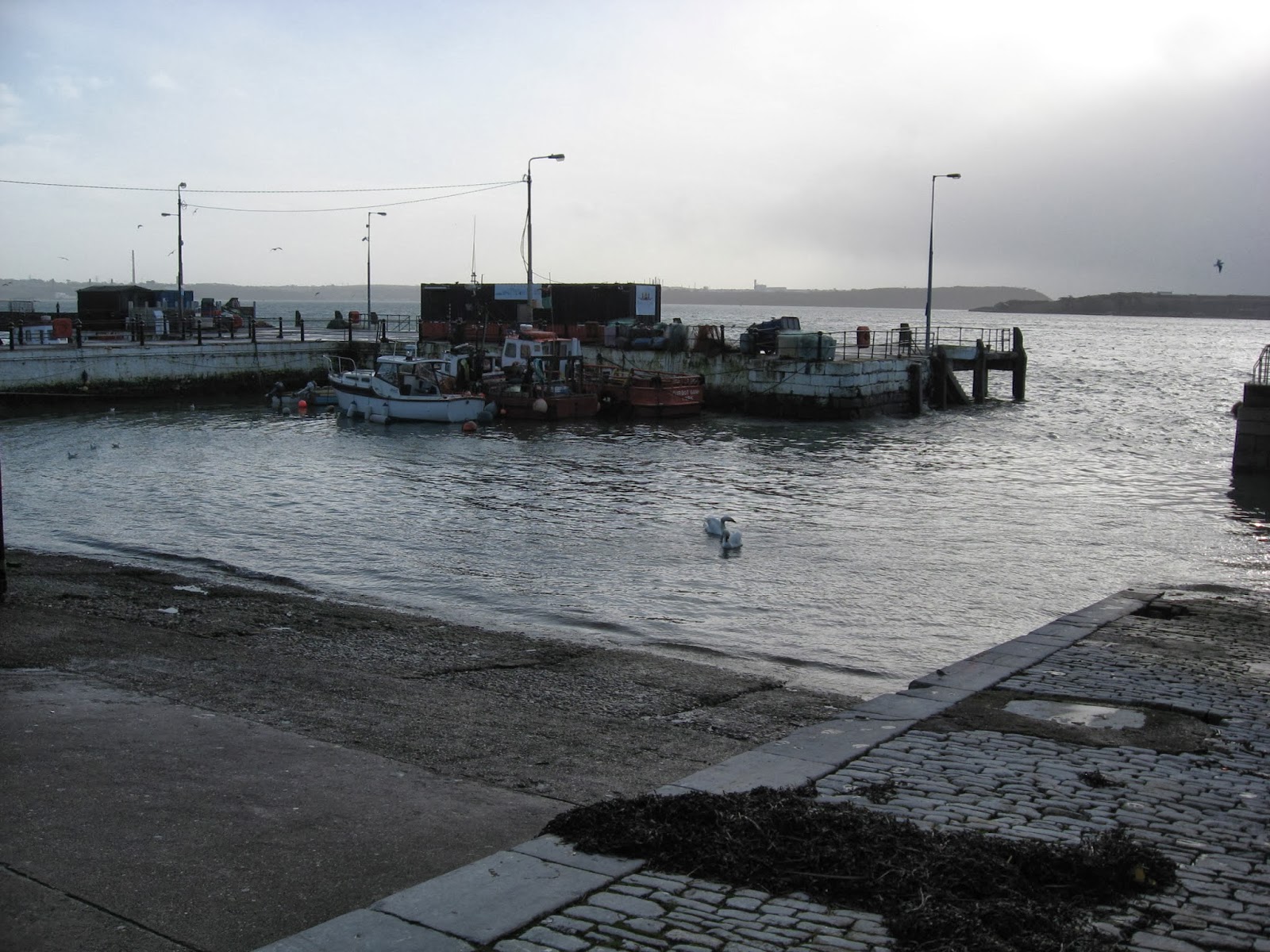
And, well, the answer is probably yes. I do plenty of brilliant (and by brilliant I mean dumb), coordinated things every week. I fall over magically appearing bikes on my way to class. I walk into fire hydrants in the middle of Fred Meyer. And I think it's a great idea to go check out the ocean by plowing down a stone ramp which leads into the ocean, without first noticing that the cobblestones are covered with seaweed. I do a spectacular butt-plant, slide halfway down the ramp, and scramble back up (only to take half the seaweed with me in exchange for half my pride). People might say I need to be more aware of my surroundings. Yes. More specifically, I need to become better at simultaneously being social and moving. It is increasingly evident that kissing the Blarney Stone did not increase eloquence levels in any aspect of my being. But eh, never give up, right?
The Spectacular Episode of the Seaweed in the Daytime is just one example of my adventures in Cobh (pronounced Cove) this past Sunday. Cobh is a small coastal town about 25 minutes train ride from Cork. A friend and I marched the 45 minutes to the Cork train station and made it just in time for the 11 am train out. The ease of taking a train was very exciting to me. I like trains, buses, subways...any sort of public transportation, really. They are great for people watching, the opportunity to observe little snippets of others' everyday lives as people enter and exit--all while maintaining a shared sense of community. I talk about it as if it is a religious experience, and it kind of is. Trains and subways aren't super available on the West Coast, or at least there aren't the hop-on, hop-off opportunities there are here. That said, the train ride to Cobh was beautiful and amazing. Yet again, we sped past another "casual ruin," as my friend likes to call them. Just an unmarked, solitary castle crumbling over the edge of jetty, next to the zoo. No big deal (but we were freaking out).

Cobh is a very nice town. I liked it a little better than Kinsale, which is another nearby, popular coastal destination. Cobh seems larger and a little less...fancy, I suppose. Cobh was the last port of call for the Titanic before its departure for New York. On 11 April 1912, 123 Irish boarded at Cobh, three days before the ship hit the iceberg. Of the 123, 44 survived. In Cobh (and many places in Cork), you will find monuments to those who died in the Titanic disaster. Cobh actually runs an exhibit entitled The Titanic Experience, which takes you through the events leading up to the sinking, shows you some model rooms aboard the Titanic, and provides snippets on the people who boarded in Cobh. At the beginning, you get assigned one of the 123 Cobh passengers. At the end, you get to check whether they survived or not. I survived. My friend survived. The guy we met off the train and traveled through Cobh with did not.
Interesting fact: At the time, the number of lifeboats required on-board a ship was not dictated by the number of passengers the ship could carry, but by the size of the ship. Though it did not have enough lifeboats for all of its passengers, the Titanic was actually carrying more lifeboats than the minimum required by law for a ship in its "bracket." Law required 16 lifeboats. The Titanic carried 20, and it had space for many more. These were not installed in favor of more desk space (though the lifeboat law was looking at imminent change).

The other must-see site I wanted to check out in Cobh was the cathedral. I was bent on finding the iconic hill with the multi-colored houses and the cathedral in the background--that picture that shows up in virtually every Ireland-themed calendar you will ever find. Well, I didn't get to the exact street, but I sure got to check out the cathedral. Man, that is some brilliant architecture. We got there just as Sunday mass was letting out. It was pouring rain, so people clustered beneath the stone entryway. There were so many people that it took at least 15 minutes of standing with everyone on the steps before the entrance was clear enough to enter. No matter--the 15 minutes provided another great round of people watching. A handful of people crossed themselves with water from a basin as they exited. A guy asked me if the taxis had arrived yet. At the time, I didn't understand him over the noise and his accent, so I just smiled and nodded, and he went to go check it out for himself. The taxis hadn't arrived yet--oops.

The inside of the cathedral was spectacularly ornate. It makes one feel small and insignificant, and I suppose that's one of the points the architecture is supposed to make. But it also feels cold and...well, I never feel happy after coming out of such cathedrals--just kind of awe-struck.

By the time we exited the cathedral, it was steadily pouring. We decided to head back to Cork around 4:30 pm and by 5 pm, it was half snowing, half raining. It was also time to walk the 45 minutes back to campus accommodation. It was a cold walk back...very cold. I hit my room and turned on the heater almost full blast--no shame. Then cleaned the kitchen and hit the hot cocoa. No shame there, either. It was an awesome day of adventuring.
And, well, the answer is probably yes. I do plenty of brilliant (and by brilliant I mean dumb), coordinated things every week. I fall over magically appearing bikes on my way to class. I walk into fire hydrants in the middle of Fred Meyer. And I think it's a great idea to go check out the ocean by plowing down a stone ramp which leads into the ocean, without first noticing that the cobblestones are covered with seaweed. I do a spectacular butt-plant, slide halfway down the ramp, and scramble back up (only to take half the seaweed with me in exchange for half my pride). People might say I need to be more aware of my surroundings. Yes. More specifically, I need to become better at simultaneously being social and moving. It is increasingly evident that kissing the Blarney Stone did not increase eloquence levels in any aspect of my being. But eh, never give up, right?
The Spectacular Episode of the Seaweed in the Daytime is just one example of my adventures in Cobh (pronounced Cove) this past Sunday. Cobh is a small coastal town about 25 minutes train ride from Cork. A friend and I marched the 45 minutes to the Cork train station and made it just in time for the 11 am train out. The ease of taking a train was very exciting to me. I like trains, buses, subways...any sort of public transportation, really. They are great for people watching, the opportunity to observe little snippets of others' everyday lives as people enter and exit--all while maintaining a shared sense of community. I talk about it as if it is a religious experience, and it kind of is. Trains and subways aren't super available on the West Coast, or at least there aren't the hop-on, hop-off opportunities there are here. That said, the train ride to Cobh was beautiful and amazing. Yet again, we sped past another "casual ruin," as my friend likes to call them. Just an unmarked, solitary castle crumbling over the edge of jetty, next to the zoo. No big deal (but we were freaking out).
Cobh is a very nice town. I liked it a little better than Kinsale, which is another nearby, popular coastal destination. Cobh seems larger and a little less...fancy, I suppose. Cobh was the last port of call for the Titanic before its departure for New York. On 11 April 1912, 123 Irish boarded at Cobh, three days before the ship hit the iceberg. Of the 123, 44 survived. In Cobh (and many places in Cork), you will find monuments to those who died in the Titanic disaster. Cobh actually runs an exhibit entitled The Titanic Experience, which takes you through the events leading up to the sinking, shows you some model rooms aboard the Titanic, and provides snippets on the people who boarded in Cobh. At the beginning, you get assigned one of the 123 Cobh passengers. At the end, you get to check whether they survived or not. I survived. My friend survived. The guy we met off the train and traveled through Cobh with did not.
Interesting fact: At the time, the number of lifeboats required on-board a ship was not dictated by the number of passengers the ship could carry, but by the size of the ship. Though it did not have enough lifeboats for all of its passengers, the Titanic was actually carrying more lifeboats than the minimum required by law for a ship in its "bracket." Law required 16 lifeboats. The Titanic carried 20, and it had space for many more. These were not installed in favor of more desk space (though the lifeboat law was looking at imminent change).
The other must-see site I wanted to check out in Cobh was the cathedral. I was bent on finding the iconic hill with the multi-colored houses and the cathedral in the background--that picture that shows up in virtually every Ireland-themed calendar you will ever find. Well, I didn't get to the exact street, but I sure got to check out the cathedral. Man, that is some brilliant architecture. We got there just as Sunday mass was letting out. It was pouring rain, so people clustered beneath the stone entryway. There were so many people that it took at least 15 minutes of standing with everyone on the steps before the entrance was clear enough to enter. No matter--the 15 minutes provided another great round of people watching. A handful of people crossed themselves with water from a basin as they exited. A guy asked me if the taxis had arrived yet. At the time, I didn't understand him over the noise and his accent, so I just smiled and nodded, and he went to go check it out for himself. The taxis hadn't arrived yet--oops.
The inside of the cathedral was spectacularly ornate. It makes one feel small and insignificant, and I suppose that's one of the points the architecture is supposed to make. But it also feels cold and...well, I never feel happy after coming out of such cathedrals--just kind of awe-struck.
By the time we exited the cathedral, it was steadily pouring. We decided to head back to Cork around 4:30 pm and by 5 pm, it was half snowing, half raining. It was also time to walk the 45 minutes back to campus accommodation. It was a cold walk back...very cold. I hit my room and turned on the heater almost full blast--no shame. Then cleaned the kitchen and hit the hot cocoa. No shame there, either. It was an awesome day of adventuring.
The Gods Must Pee


Monday, January 20, 2014
Blarney Castle


This here child leaned 4 feet over the edge of a castle roof to kiss a stone that locals pee on. At least she hopes she kissed the Blarney stone, not the one above it, because she certainly could do with a little more eloquence of speech (and let's not even talk about eloquence of movement). But it is becoming clearer and clearer that she probably kissed the stone above....
Legend has it that the Blarney stone will bestow the gift of eloquence upon anyone who is crazy enough to put their life in peril to kiss it. To this date, I have heard of no person falling to their death...but then that would significantly diminish tourist appeal. However, Blarney Castle is awesome on its own if you don't want to lean 4 feet out from the castle roof. Unlike sites in the States, you can run through it At Your Own Risk. Climb that ridiculously steep stone stairwell dripping with water. Crawl through the castle's underground tunnels (oh hey, a giant spider). Hang ten over its parapets. Nothing's going to stop you, because you give up your rights to sue the minute you step through the castle gates and under the entrance's murder hole (where unwelcome visitors might have rocks dropped on their heads, or boiling oil, or some other unfortunate substance). And if that's not great enough, the castle also has its own poison garden. Stroll through isles of wolfsbane and yew and nightshade. Marvel at how many such plants you have in your garden (that's 75% for the Wyman clan, folks). Notice that dear mother is looking a little too pleased and decide that it's time to check out the arboretum. Rock out navigating back to Cork in the rental car. Final impression: Blarney Castle is amazing. Go there.
Colaiste na hOllscoile Corcaigh
That, my friends, is the Irish name for University College Cork. And this, my friends, is the building that will pop up in 90% of pictures if you Google image search UCC.

This is the Aula Maxima. UCC is very proud of it.
There are several pretty interesting student myths concerning the Aula Maxima:
1) If you walk directly across the quad, you will fail your exams. It used to be that exam results were posted on one end of the quad and the president's office was on the other. If you failed an exam, you would have to walk across the quad to go have a little chat with the president. This was known as The Walk of Shame.
2) If you continue out of the left of the picture, there is an arched walkway that leads into a parking lot. On the ground directly in the center of the walkway is a tile motif. Legend has it that if you walk over this motif, you will either get pregnant or get your girlfriend pregnant. Luckily, the city center has a crisis pregnancy services center. Legend also has it that this story was invented by those who placed it there so they wouldn't have to replace the motif so often. But I'm not taking any chances.
The building is home to the visitor center, several administrative offices, and several classrooms. I had class in this building once, before I decided that I'd rather take Celtic Religion and Mythology.
This is the Aula Maxima. UCC is very proud of it.
There are several pretty interesting student myths concerning the Aula Maxima:
1) If you walk directly across the quad, you will fail your exams. It used to be that exam results were posted on one end of the quad and the president's office was on the other. If you failed an exam, you would have to walk across the quad to go have a little chat with the president. This was known as The Walk of Shame.
2) If you continue out of the left of the picture, there is an arched walkway that leads into a parking lot. On the ground directly in the center of the walkway is a tile motif. Legend has it that if you walk over this motif, you will either get pregnant or get your girlfriend pregnant. Luckily, the city center has a crisis pregnancy services center. Legend also has it that this story was invented by those who placed it there so they wouldn't have to replace the motif so often. But I'm not taking any chances.
The building is home to the visitor center, several administrative offices, and several classrooms. I had class in this building once, before I decided that I'd rather take Celtic Religion and Mythology.
The Rental Car

Pictured: Navigator, assistant to Driver. Operation Badass Parking Job at Timoleague Abbey.
We had to be very careful not to take out the 11th century wall in front. ("Careful...oh, there goes a national monument. Well shoot.") This harkens back to the days of Wymana: Student Driver, trying to park in a deserted church parking lot. ("You just took out the chevrolet. There goes the porsche. STOP. That's the ferrari. Okay, let's try that again.")
Subscribe to:
Posts (Atom)